
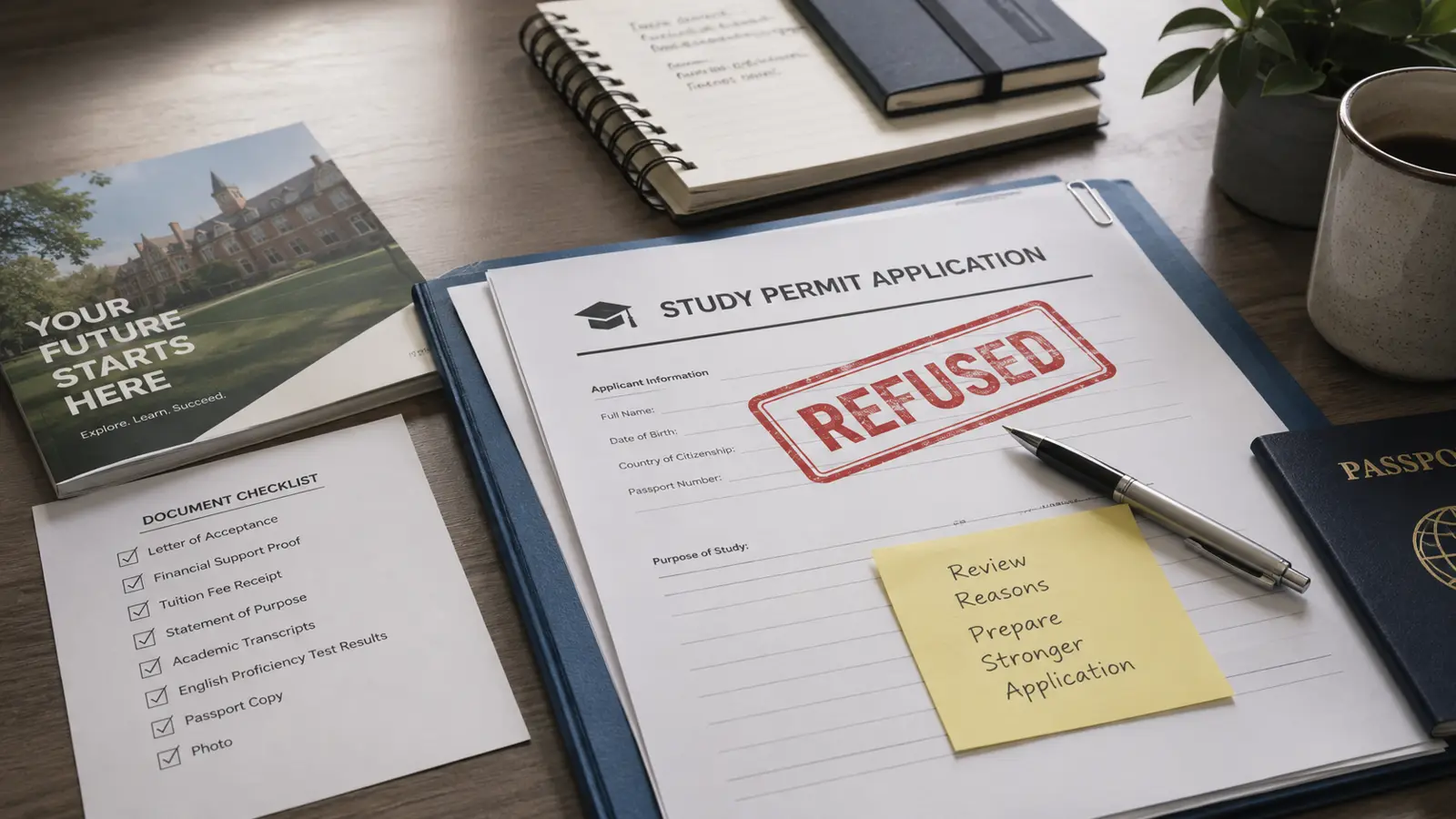
This article provides general information about study permit refusals. It does not assess an individual application or replace advice from an authorized immigration representative.
Quick answer: what should I do after a study permit refusal?
Start with your refusal letter, the officer decision notes and the application you submitted. Identify the concern, then check what evidence was missing, inconsistent or unconvincing before deciding whether to apply again.
IRCC allows reapplication without a general waiting period unless the decision letter says otherwise, but says you should include information you did not provide before. Sending the same application again does not address the refusal. A new application does not guarantee approval.
See IRCC's reapplication answer[1]. If you are already in Canada, also check your current status and study or work authorization promptly; a plan to reapply is not permission to continue studying or working.
Common study permit refusal concerns: what to review
This is a review framework, not a ranking of refusal reasons or a prediction for an individual case.
| Concern in the decision | Evidence to review |
|---|---|
| Purpose of study or program choice | Explain the specific program, its connection to your history and your realistic career plan; check that admission documents match. |
| Financial support | Review tuition, living expenses, transportation, access to funds and the documented source of money or sponsor support. |
| Whether you will leave Canada when required | Review the temporary study plan and your actual circumstances; property ownership is not a universal requirement. |
| Missing or inconsistent information | Compare forms, dates, education, employment and previous immigration history with the supporting documents. |
| School or attestation documents | Recheck the LOA, DLI, start date and whether a new PAL/TAL or Quebec CAQ is required. |
IRCC's study permit eligibility rules[2] remain the starting point. The sections below explain how to review these concerns without inventing facts or relying on a generic SOP.
Start with the decision, not a template
A study permit refusal is a decision about the application that was submitted. It is not a verdict on the applicant’s character, and it is not necessarily a finding that the proposed education has no value.
The useful starting point is the refusal letter and any officer decision notes provided with it. Since July 29, 2025, IRCC has included officer decision notes with refusal letters for most temporary resident applications. The notes may identify the facts or evidence that mattered to the decision, although they do not turn every refusal into a detailed legal opinion.
How do I get the officer decision notes?
IRCC sends the notes and refusal letter to you or your authorized representative for covered applications, including study permits and extensions. Check both documents and, if represented, request a complete copy from your representative. Portions may be withheld to protect sensitive information; the note is not necessarily the complete record used in a court proceeding.
See IRCC's officer decision notes explanation[3].
Read those documents beside a complete copy of the original application. A generic list of “common refusal reasons” cannot show whether the concern was the study plan, financial evidence, missing documents, credibility, admissibility or a combination of issues.
For related preparation, see CADLEAF’s guide to writing a study permit statement of purpose[4] and the overview of planning a Canadian study journey[5].
What the officer must decide
The legal test is broader than admission to a Canadian school.
Under section 216 of the Immigration and Refugee Protection Regulations, an officer must be satisfied that the applicant applied as required, will leave Canada by the end of the authorized stay and meets the applicable requirements. IRCC’s published eligibility guidance also addresses enrolment at a designated learning institution, financial support, admissibility and medical or police requirements where applicable.
A plan to pursue permanent residence in the future is not automatically disqualifying. Section 22(2) of the Immigration and Refugee Protection Act recognizes “dual intent”: a person may have a future permanent-residence intention and still qualify as a temporary resident. The officer must nevertheless be satisfied that the person would leave Canada when required if no further status were granted.
That is why an application should deal honestly with both the immediate purpose of study and the temporary conditions attached to the permit.
The study plan has to be supported by the record
IRCC’s published eligibility criteria do not impose a universal rule that every new program must be at a higher academic level or in the same field as previous education. Career changes, professional retraining and specialized credentials can all have legitimate explanations.
Questions arise when the reason for the program is difficult to follow from the documents. For example, the application may not explain:
- why this particular program was chosen;
- how it relates to the applicant’s education or employment;
- what knowledge or credential the applicant expects to gain;
- why the timing is reasonable; or
- how the program fits a realistic career plan.
The explanation should be specific to the applicant’s history. Promotional statements about Canada’s education system do little to explain why one person selected one program at one institution.
A statement of purpose can connect the evidence, but it cannot repair contradictory forms, an ineligible school or missing mandatory documents.
Financial evidence is more than a closing balance
IRCC requires evidence that the applicant can cover tuition, living expenses and transportation for themselves and accompanying family members without relying on work in Canada. Show funds for the first year and, for a longer program, explain the funding plan for the remaining studies. The required living-expense amount can change, so the current figure should be taken from IRCC’s proof-of-financial-support page when the application is prepared.
IRCC lists several possible forms of evidence, including tuition or housing payments, bank records, a qualifying guaranteed investment certificate, an education loan, scholarship funding and financial support from another person or institution. The documents that make sense will depend on how the studies are being funded.
The application should allow an officer to understand:
- who owns the funds;
- whether the money is available for the proposed studies;
- how tuition, living costs and transportation will be covered;
- how a sponsor, loan or scholarship fits into the plan; and
- the source of any significant recent transfer.
A large deposit is not automatically improper. It may come from a legitimate sale, loan disbursement, matured investment or family support. The concern is whether the application documents the source and availability instead of leaving an unexplained balance.
Avoid treating a single bank statement as a substitute for a realistic budget. Tuition already paid may help demonstrate preparation, but IRCC states that it must be accompanied by evidence of sufficient funds for living expenses and transportation.
Check the school documents again
Most study permit applications require a letter of acceptance from a designated learning institution. A provincial attestation letter or territorial attestation letter is also required in many cases, although IRCC lists exceptions.
These rules deserve a fresh check before any reapplication. In particular, IRCC states that a PAL or TAL generally cannot be reused when the previous study permit application was refused. If a PAL/TAL is required, the applicant normally needs a new valid document before reapplying.
The exemption rules have also changed over time. For example, certain degree-granting master’s and doctoral programs at public DLIs are PAL/TAL-exempt for applications made after January 1, 2026. The current IRCC page—not an older checklist or social-media post—should determine whether an exception applies.
Confirm the institution on IRCC’s DLI list and make sure the letter of acceptance, program dates, tuition information and PAL/TAL evidence all refer to the intended application.
Home ties and travel history are contextual, not checkboxes
Property ownership and extensive international travel do not appear as stand-alone requirements on IRCC’s study permit eligibility page. Their absence should not be described as an automatic ground for refusal.
An officer may still consider the applicant’s circumstances when assessing whether the temporary-residence requirement is met. Employment, family responsibilities, finances, previous immigration compliance and the proposed career plan may all provide context. The relevance and weight of each factor depend on the facts.
This is an area where copied language often causes more harm than help. A paragraph claiming “strong ties” is less useful than accurate documents and a concise explanation of the applicant’s actual circumstances.
Travel history should also be presented accurately. Applicants should not take unnecessary trips simply to make a passport look more persuasive, and they should never omit previous refusals or immigration history.
Consistency matters across the entire application
Officers do not read the statement of purpose in isolation. Dates, employment records, education history, family information, financial documents and answers in the application forms should agree with one another.
Review the application for differences such as:
- employment dates that conflict with a résumé or reference letter;
- funding claims that do not match bank or sponsor records;
- unexplained gaps in study or work history;
- inconsistent program names or start dates;
- family information that differs from an earlier application; or
- a previous refusal that was not disclosed.
Never alter a document or invent an explanation to make the application appear more convenient. False or misleading information can create consequences that extend well beyond the study permit decision.
Can I reapply after a Canadian study permit refusal?
IRCC does not generally require a waiting period before another application unless the decision letter says otherwise. That does not mean an immediate resubmission is useful.
Before filing again:
- Read the refusal letter and officer decision notes.
- Compare each concern with the evidence that was actually submitted.
- Correct factual mistakes and inconsistent forms.
- Obtain any new mandatory document, including a new PAL/TAL when required.
- Add relevant evidence that directly answers the concern.
- Update information that has changed since the first application.
- Remove generic material that does not help the officer assess the requirements.
A longer statement of purpose is not automatically a better one. The revised application should explain what is different and support that difference with evidence.
Reapplying and challenging a decision in Federal Court are different processes. Anyone considering a legal challenge should obtain timely advice from a Canadian lawyer because court procedures and deadlines are not the same as submitting a new application.
Related CADLEAF student guides
- Study permit statement of purpose: explaining your evidence[4]
- Study in Canada: school, documents and planning[5]
- Study permit extensions, maintained status and restoration[6]
- Working while studying: eligibility and limits[7]
A disciplined review before submission
Before another application is filed, verify:
- the current study permit eligibility rules;
- the DLI and letter of acceptance;
- PAL/TAL or CAQ requirements and any claimed exception;
- the current financial-support amount;
- a budget that covers tuition, living expenses and transportation;
- consistent education, work and family histories;
- translations and document legibility;
- truthful disclosure of previous applications and refusals; and
- a study explanation that is anchored in the applicant’s actual record.
The goal is not to predict approval. It is to submit an application that accurately addresses the legal requirements and the concerns raised in the earlier decision.
Official sources
Check the current rules and documents directly before applying:
- IRCC: Study permit eligibility[2]
- IRCC: Documents required for a study permit[8]
- IRCC: Proof of financial support[9]
- IRCC: Provincial or territorial attestation letter[10]
- IRCC: Designated learning institutions list[11]
- IRCC: Officer decision notes included with refusal letters[3]
- Immigration and Refugee Protection Regulations, section 216[12]
- Immigration and Refugee Protection Act, section 22[13]
- IRCC Help Centre: Applying again after a refusal[1]
Editorial transparency
Review and source transparency
What “Last reviewed” means: CADLEAF substantively checked this article’s immigration information against current primary sources on that date. A routine wording, formatting, or style edit does not create a new review date.
A review date does not guarantee that a rule, form, fee, program instruction, or policy has stayed unchanged since. Verify important details on the current official source before acting.
- Published
- July 15, 2026
- Last reviewed
- September 27, 2026
- Material updates recorded
- 2
Corrections and important updates
Routine spelling, formatting, and style edits are not recorded as corrections.
Added direct refusal and reapplication answers, a concern-to-evidence review table and related student guides; rechecked current IRCC refusal notes, PAL/TAL and financial-support instructions.
Rewritten after a primary-source review to distinguish legal requirements from contextual evidence, explain current refusal notes and PAL/TAL rules, and add direct official sources.
Quick questions
Common questions about this guide
What should students verify after reading Canada Study Permit Refusal: Reasons, Officer Notes and Reapplying?
Confirm the current DLI and program details, study permit instructions, proof-of-funds requirements, PAL/TAL rules where applicable, work conditions, and any PGWP rules relevant to the program.
Where should I confirm current study permit or PGWP rules?
Use the current IRCC study permit and PGWP pages, plus the official DLI information for the school and program. Requirements can differ by program, start date, credential, and the student's circumstances.
Important note: This article is for general information only. It is not immigration consultant advice or legal advice. Immigration rules and policies can change. Always check official Government of Canada and IRCC sources before making decisions.
Continue
Helpful next steps
Plan your studies in Canada
Review school and program choices, study-permit documents, costs, work rules, and PGWP considerations before applying.
Understand student work rules
Check when international students may work, the off-campus hour limit, scheduled breaks, and when work must stop.
Plan for a PGWP
Review program, language, field-of-study, timing, work-authorization, and post-graduation planning considerations.
Verify current IRCC PGWP rules
Open the official IRCC eligibility page for current program, study, language, field-of-study, location, and timing requirements.
Sources and links
Links referenced in this article
To keep the article focused on reading first, links referenced in the text are collected here.
More from CADLEAF